Bond Exchange-Traded Funds – basics, examples, a comparative study
Bond ETFs – basics
Ingredients
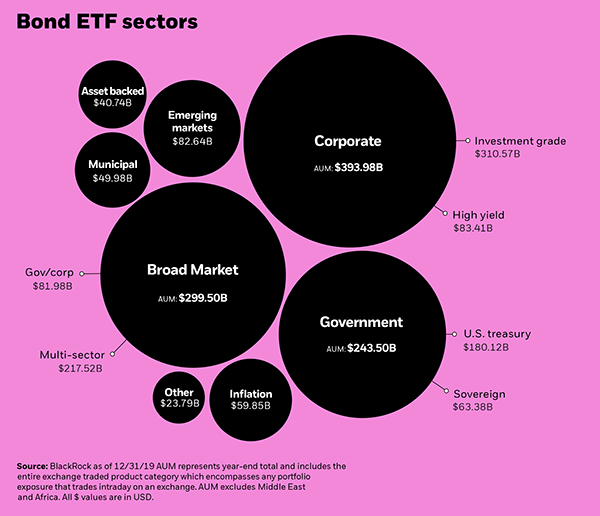
Bond ETFs are passively managed Exchange-Traded Funds (ETFs) that consist solely of fixed-income securities. The types of bonds comprising a given bond ETF can include those of different strategies such as U.S. Treasuries, high-yield bonds, corporate bonds, convertible bonds, floating-rate bonds. Also, bonds within a given bond ETF can include those of different holding periods such as long-term and short-term.
Trading
Bond ETFs are traded on major stock exchanges. Investors gain passive exposure to benchmark bond indices at low-cost.
Laddering
By obtaining multiple fixed-income securities each of which have a different maturity date – intentionally spread across several months/years – the proceeds can be reinvested regularly as each bond matures. By making multiple smaller bond purchases with varying dates, interest-rate risk can be hedged against, liquidity can be staged, and credit risk can be diversified.
Bond selection
High inflation and rising interest rates depress the value of long-term bonds. Conversely, then, as interest rates rise, bond ETFs experience higher yields.
Bonds within the broader portfolio
Bonds provide an anchor-point of fixed income within a well-diversified investment portfolio.
Awareness
Bonds investors should stay aware of the effect of interest rate changes.
Notes
- Bond mutual funds include active management.
- Bonds ETFs are recommended for investors looking to buy/sell frequently.
Case Studies
GOAL: To see what ETF recommendations may persist across volatility, as volatility was experienced in Fall 2022.

August 2022 – kiplinger
AUGUST 2022
- In August 2022, Kiplinger determined their 10 Best Bond ETFs to Buy Now.

| Kiplinger 2022 | Forbes 2023 |
| iShares Core U.S. Aggregate Bond ETF – AGG | iShares Inflation Hedged Corporate Bond ETF (LQDI) |
| iShares 20+ Year Treasury Bond ETF – TLT | Vanguard Total International Bond ETF (BNDX) |
| Vanguard Long-Term Corporate Bond ETF – VCLT | iShares Interest Rate Hedged High-Yield Bond ETF (HYGH) |
| Vanguard Short-Term Corporate Bond ETF – VCSH | iShares 0-5 Year TIPS Bond ETF (STIP) |
| Vanguard Total International Bond ETF – BNDX | SPDR Nuveen Bloomberg Short-Term Municipal Bond ETF (SHM) |
| iShares TIPS Bond ETF – TIP | Vanguard Short-Term Corporate Bond ETF (VCSH) |
| iShares Floating Rate Bond ETF – FLOT | Nuveen Enhanced Yield 1-5 Year U.S. Aggregate Bond ETF (NUSA) |
| iShares iBoxx $ High Yield Corporate Bond ETF – HYG | |
| iShares National Muni Bond ETF – MUB | |
| Fidelity Total Bond ETF – FBND |
 still creek investing